The nonprofit sector entered 2026 still absorbing the aftershocks of the global disruptions that began in early 2025. Those shocks (including economic uncertainty, shifting public policy, and volatility in capital markets) have had a disproportionate impact on nonprofits, whose funding is deeply tied to donor confidence, institutional stability, and long-term commitments.
If there were concerns heading into 2025, the reality proved even more severe. Federal funding programs tightened significantly, and in many cases, state-level support followed suit or collapsed entirely. What had once been relatively predictable funding streams became unreliable, delayed, or disappeared altogether.
Now, in Q2 2026, the funding landscape has not stabilized so much as it has transformed. At first glance, the situation appears contradictory. Total charitable giving remains historically high. According to Giving USA, U.S. charitable giving reached $592.5 billion in 2024, growing 6.3% year over year (3.3% adjusted for inflation). While 2025 data is not yet finalized, there is little indication of a dramatic drop in total dollars.
So what’s the problem?
The issue is not the total amount of money in the system; it is access.
A Structural Shift, Not a Temporary Downturn
Nonprofits are operating in what can best be described as a structurally constrained funding environment. While aggregate funding remains strong, it is increasingly concentrated among fewer funders and fewer recipient organizations.
Large, well-established nonprofits are generally maintaining or even expanding their funding. In contrast, small and mid-sized organizations are becoming more financially fragile. According to the Urban Institute, 21% of nonprofits reported losing government funding in the first half of 2025, while 27% experienced delays, pauses, or freezes.
At the same time, the number of available funding opportunities has declined. Decision cycles have lengthened. More grants are now invitation-only. Foundations are prioritizing multi-year commitments to existing partners rather than onboarding new grantees. In practical terms, this means that even when money exists, fewer organizations can access it.
The Closed Loop Problem
One of the most defining features of the current environment is the “closed loop” system. Approximately 77% of grants are going to organizations that have already been funded. Foundations are doubling down on known entities, reducing perceived risk by limiting exposure to new applicants. While this strategy may increase efficiency for funders, it creates a significant barrier for emerging or smaller nonprofits.
The result is a reinforcing cycle: organizations that already have funding relationships continue to receive support, while those outside these networks struggle to break in. Access, rather than merit or need, has become the primary bottleneck.
Core Challenges Facing Nonprofits
Several pressures are converging at once:
Donor base erosion is accelerating. While major gifts remain relatively stable, the total number of donors is declining, particularly among small-dollar contributors. Retention rates are weakening, making it harder to build reliable, long-term pipelines.
Competition for foundation funding is intensifying. Around 87% of funders report increased demand for grants, even as many shift to invitation-only models or close Letters of Inquiry (LOIs) earlier. Access barriers are rising. Funding decisions are increasingly relationship-driven, favoring organizations with existing connections over those submitting cold applications.
Government funding has become unpredictable. Cuts, delays, and administrative bottlenecks have made it difficult for nonprofits to plan or rely on public funding streams. Individual giving is more volatile. While large gifts persist, grassroots giving is declining, creating instability for organizations that depend on broad donor bases.
Equity gaps are widening. Many grassroots and community-based organizations (particularly those that missed the surge of funding after 2020) are struggling to access institutional capital. Funding is concentrating among larger, well-networked organizations with established credibility.
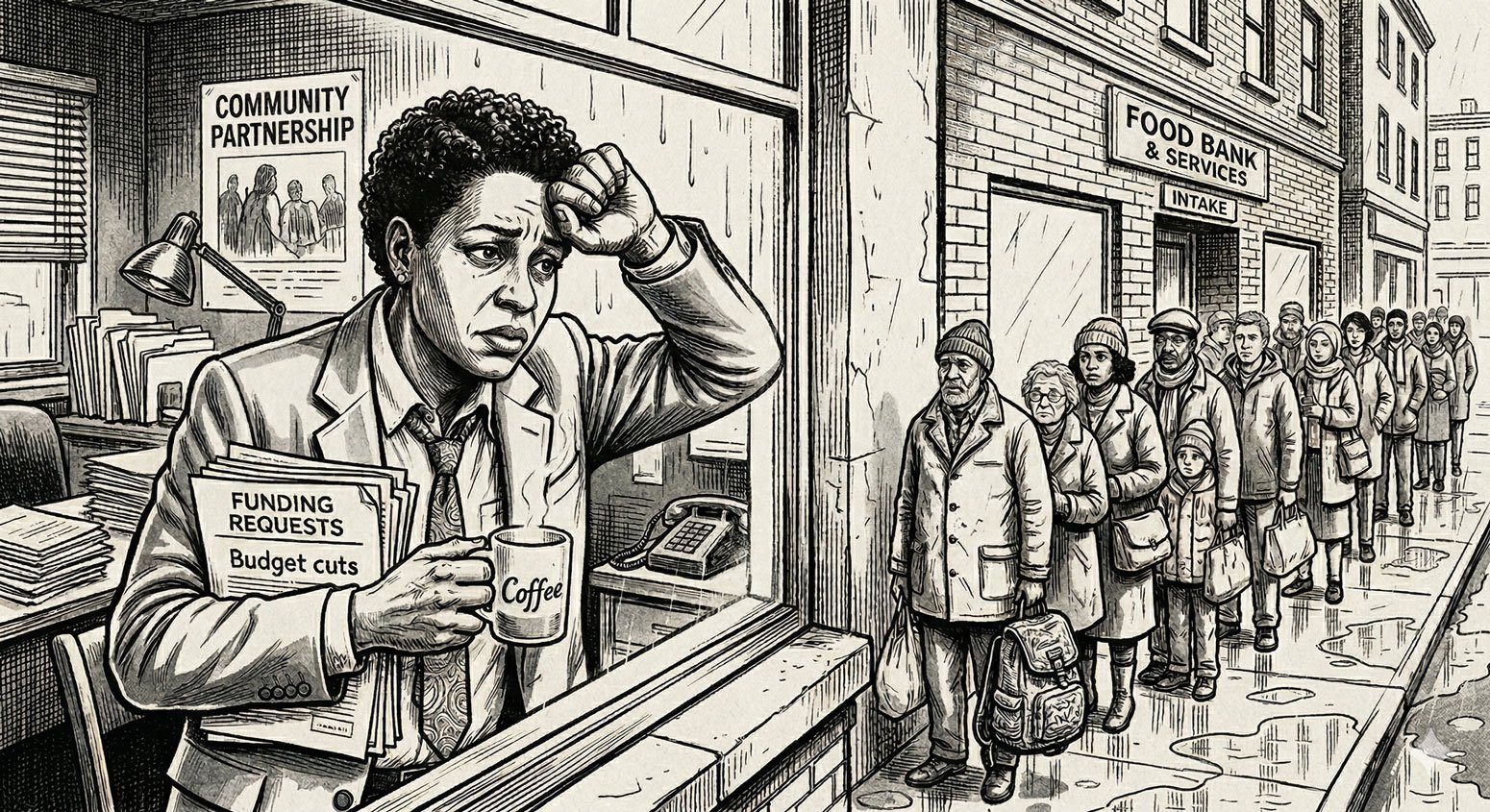
At the same time, demand for services continues to rise (especially in human services sectors such as housing, food security, and reentry programs). Inflation is increasing the cost of delivering those services, forcing nonprofits into an increasingly unsustainable position: serving more people with fewer flexible resources.
Where Funding Is Still Flowing
Despite these challenges, the landscape is not without opportunity. Funding has not disappeared; rather, it has shifted. Major donors and high-net-worth individuals are playing an increasingly important role. As wealth concentration grows, some nonprofits are adapting by focusing on deeper and more strategic relationships with their donors. Human services organizations remain a priority for many funders, particularly when their work aligns clearly with urgent, visible needs such as homelessness or food insecurity.
Digital fundraising continues to grow, with online giving increasing by an estimated 10–15% year over year. This creates new opportunities for direct-to-donor engagement, recurring giving programs, and broader geographic reach. Corporate and foundation giving remains relatively strong. Corporate giving has risen by roughly 9%, and foundation funding continues to grow modestly, even as access tightens.
Looking further ahead, the Great Wealth Transfer (the ongoing intergenerational transfer of trillions of dollars) will reshape philanthropy over the coming decades. Organizations that prioritize building relationships in concert with creating efficient and optimized systems will benefit significantly as a new generation of potential philanthropists emerges.
A New Playbook for Nonprofits
Success in this environment depends less on submitting a deluge of grant applications and more on strategy.
The most effective organizations are shifting their focus toward:
In short, the challenge is no longer simply “how to find funding,” but “how to gain access to the right funding channels.” The nonprofit funding environment in Q2 2026 is not defined by scarcity, but by concentration, competition, and constrained access. Organizations that recognize this shift and adapt accordingly will be far better positioned to navigate what is likely to remain a complex and uneven landscape.