For decades, Americans have been told a comforting story that when times get tough, the safety net will hold. What’s less often acknowledged is who is actually doing the holding.
It’s not just government agencies. Increasingly, it’s nonprofits including food banks, housing groups, mental health providers, and small community organizations quietly absorbing the shocks of policy decisions they didn’t make and can’t control. As public funding becomes more volatile, these organizations are no longer just partners in delivering services. They are becoming the system of last resort.
That shift didn’t happen overnight. Since the 1960s, governments have steadily outsourced social services, choosing to contract with nonprofits rather than build out large public bureaucracies. The logic was straightforward: nonprofits are closer to communities, more flexible, and often more trusted. By the time welfare reform reshaped the landscape in the 1990s, this model was firmly entrenched. Job training, foster care, homeless advocacy, and other safety‑net services were already being handled by nonprofits or, in worse cases, for‑profit corporations.
For a while, the arrangement seemed to work. Public agencies set priorities and provided funding; nonprofits did the day-to-day work. But that balance is now under strain.
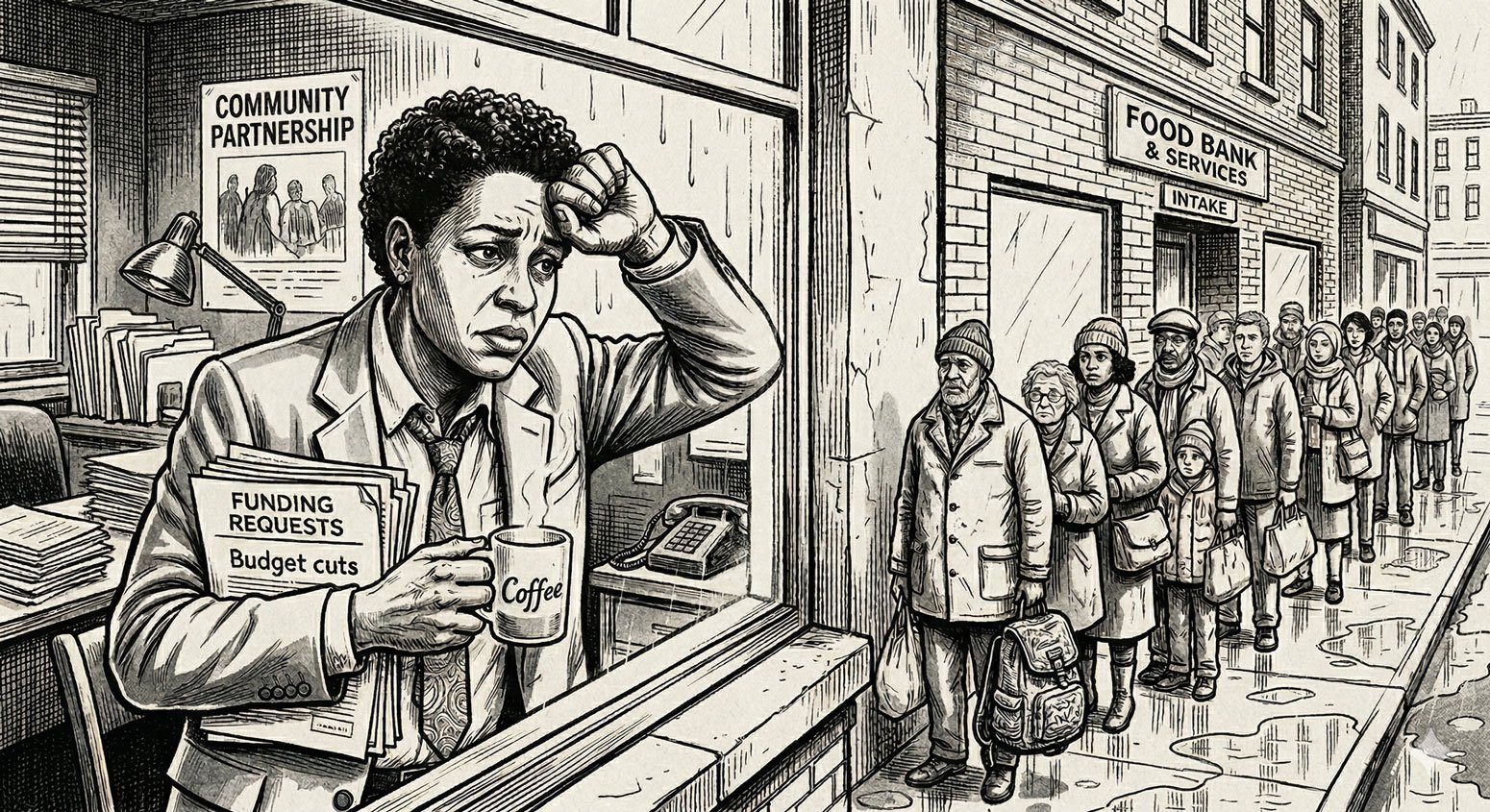
In the past two years, nonprofits across the United States have faced a wave of funding disruptions, delays, cuts, freezes, and outright cancellations. For organizations that depend heavily on government contracts, even a short delay can mean layoffs, reduced services, or closing their doors altogether. Unlike governments, nonprofits don’t have the ability to run deficits indefinitely. And unlike businesses, they can’t simply raise prices when costs go up.
Yet when they falter, the need doesn’t disappear. It grows.
Walk into a food pantry during a funding gap and you won’t see fewer people in line. Talk to a housing nonprofit that lost a contract and you won’t hear about fewer families needing shelter. The demand is relentless, and increasingly, nonprofits are expected to meet it regardless of whether the funding shows up on time or at all.
Philanthropy is often held up as the backup plan. It isn’t. Charitable giving can help in a crisis, but it lacks the scale and consistency of public funding. A foundation grant might keep a program alive for a year. It won’t sustain a statewide system of care.
This is the quiet contradiction at the heart of modern social policy. Governments continue to rely on nonprofits to deliver essential services, while simultaneously making that work harder to sustain. The result is a system that looks stable from the outside but is increasingly fragile.
To be clear, nonprofits bring real strengths to this work. These are the organizations that are deeply embedded in the community and able to build trust in ways that large institutions cannot. Social service nonprofits innovate, adapt, and stretch limited resources further than most would think possible. They have in some areas become what passes for a stable public safety net.
If current trends continue, we are likely to see a widening gap between what people need and what nonprofits can realistically provide. Housing pressures, mental health crises, and economic inequality are all intensifying. At the same time, funding uncertainty is pushing organizations into a constant state of triage focusing on survival rather than long-term solutions.
There is still time to rethink this trajectory. Governments don’t need to abandon partnerships with nonprofits, but they do need to treat them as essential infrastructure rather than expendable contractors. That means reliable funding, timely payments, and policies that recognize the true cost of delivering services and not just the lowest bid. Nonprofits are the last line of defense. And right now, that line is under more pressure than most people realize. If the system of nonprofits that holds a large swath of Americans above water fails, societal upheaval is likely to follow. There isn’t another layer waiting underneath.